Software Solutions
Learn More
Company Information
Announcements
CONGRATULATIONS to Brad Drayton!!
He is the winner of our Android Tablet Contest
EXAMPLES
EXAMPLE 2 - Splitting Thermal Growth
This system shown in Fig. 2A is made of three pipe sizes:
- 4" NB/Sch. 40: Between nodes 10 and the first reducer
- 6" NB/Sch. 40: Between the first reducer and the second reducer and ending at node 90
- 8" NB/Sch. 40: Between nodes 90 and anchor node 130
- T=470°F
![]() |
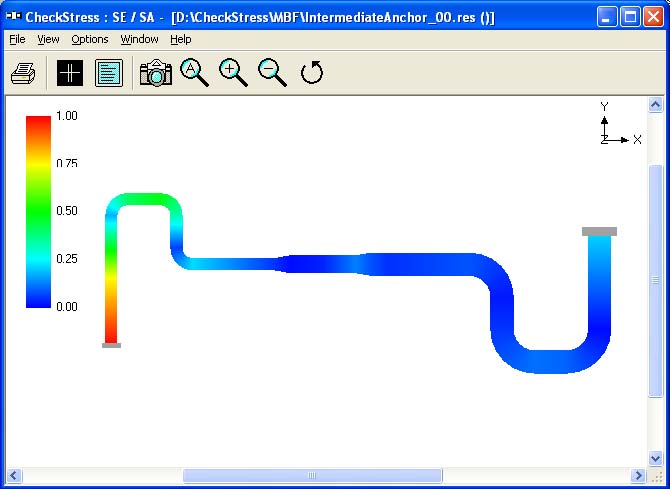
Since the loop between nodes 10 and 40 is much more flexible (as it is made of 4” pipe) than the loop between nodes 100 and 130, the straight pipe between nodes 40 and 100 will thermally grow mostly towards the 4” loop, as shown in Fig. 2B, straining the pipe between nodes 10 and 40.
![]() |
This, in turn, produces large thermal stresses (i.e., orange and red zones) in the 4” loop and at anchor node 10, as observed in Fig. 2C. In other words, the thermal growth of pipe between nodes 40 and 100 is mostly absorbed by the 4” loop and very little by the 8” loop, defeating the very purpose of the 8” loop.
![]() |
In order to alleviate thermal stresses in the 4” loop, introduce an intermediate anchor at node 95 immediately after the second reducer, so that the thermal growth of straight pipe from node 95 to node 100 is absorbed by the 8” loop, while the thermal expansion of straight pipe between nodes 40 and 95 is absorbed by the 4” loop, thereby making both loops achieve their intended purpose. The corresponding thermal displacement and thermal stress contour plots are given in Fig. 2D and Fig. 2E respectively.
![]() |
![]() |
Fig. 2F confirms that the present configuration with only two equipment nozzles at nodes 10 and 130 and an intermediate anchor at node 95 safely meet the code stress requirement for sustained load.
![]() |