Software Solutions

Learn More

Company Information

Announcements

CONGRATULATIONS to Brad Drayton!!

He is the winner of our Android Tablet Contest

See Details

EXAMPLES


EXAMPLE 3 - Axial Restraints to Direct Thermal Growth


This problem shows how axial restraints (i.e., pipe supports that prevent movement along a pipe’s axis) can be effectively used to direct thermal growth towards expansion loops and split thermal growth in a line such that the two piping portions grow in opposite directions.


Figure 3A - Layout with Intermediate Anchor at Node 95

Fig. 3A shows the same problem as in Example 2 but with a 6” NB branch line added at the welding tee at node 70 (i.e., from node 70 to node 240).

The deformed geometry, due to the thermal load (Fig. 3B), shows that the tee at node 70 does not move up in +Y-direction. The intermediate anchor at node 95 restrains the vertical riser (between nodes 220 and 70) from thermally growing upward towards node 70. As a result, this riser grows downward producing large bending moments and stresses at and around equipment nozzle at node 240.

Figure 3B - Thermal Deformation Plot

Since the intermediate anchor effectively restrains upward growth of this vertical riser node 70, we see large localized thermal stress at the welding tee. See thermal stress contour plot shown in Fig. 3C.

Figure 3C - Thermal Stress Contour Plot

Figure 3D - Layout with Axial Restraints at Node 95 and 210

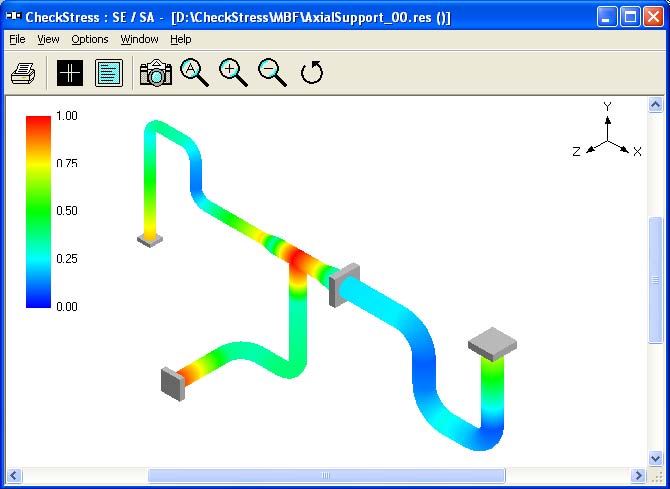
Fig. 3D shows the same piping system with one axial restraint at 95 (replacing the intermediate anchor at node 95) and another at node 210 — the one at node 95 splits and directs thermal growth towards the 4” and 8” loops and permits the horizontal line to move up in +Y-direction at node 70; the second one at node 210 splits the thermal growth of the vertical riser (between nodes 220 and 70). The resulting deformed geometry plot in Fig. 3E shows a more flexible system, which produces smaller forces and moments, and hence stresses at the equipment nozzle node 240 and welding tee node 70.

Figure 3E - Thermal Deformation Plot for Layout with Axial Restraints

Figures 3F and 3G show the thermal and sustained stress contour plots (in this case sustained stress is due to only deadweight as pressure is zero), confirming a code-compliant system for both load cases.

Figure 3F - Thermal Stress Contour Plot for Layout with Axial Restraints

Figure 3G - Sustained Stress Contour Plot for Layout with Axial Restraints

Example 1

Example 2

Example 4

Example 5

Watch Video of checkSTRESS in action

checkSTRESS Home