Software Solutions
Learn More
Company Information
Announcements
CONGRATULATIONS to Brad Drayton!!
He is the winner of our Android Tablet Contest
EXAMPLES
EXAMPLE 4 - Locating Supports For Deadweight Analysis
This problem illustrates how to select and locate vertical supports to carry piping deadweight in the operating condition.
Fig. 4A shows a practical problem with 10” NB Standard schedule pipe from equipment nozzle at node 5 up to the reducer at node 30, 8” NB Standard schedule pipe from this reducer to the pump nozzle at node 40, and a 6” NB Standard schedule branch line from the welding tee at node 25 to the equipment nozzle at node 125.
![]() |
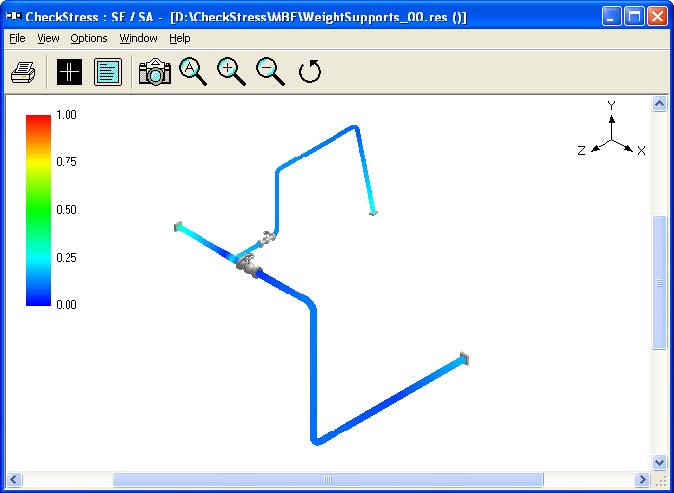
The thermal stress contour plot given in Fig. 4B confirms that the piping system is highly flexible and hence meets the code requirement for thermal load.
![]() |
Fig. 4C shows the deflected shape for sustained load (i.e., mainly deadweight). It is observed that the weight of (i) the horizontal line from node 5 to node 15 and (ii) a major portion of the vertical riser from node 15 to node 20 is carried by the equipment nozzle at node 5; on the other hand, the pump nozzle at node 40 carries the weight of (i) the horizontal line from node 20 to node 40, (ii) the valve portion of the branch line from node 25 to node 125 and (iii) a small portion of the vertical riser from node 15 to node 20.
![]() |
The deformation response for deadweight, in turn, generates large forces and moments and hence large sustained stresses at nozzle nodes 5 and 40 as shown in Fig. 4D for sustained stress contour plot.
![]() |
Fig. 4E shows the same layout with variable spring hangers at the bends at nodes 20 and 115, which carry piping deadweight and provide negligible restraint to thermal movement from cold to hot condition and vice versa.
![]() |
The thermal and sustained stress contour plots given in Fig. 4F and Fig. 4G confirm that the piping system with hangers is code-complaint for both sustained and thermal load cases.
![]() |
![]() |