Software Solutions
Learn More
Company Information
Announcements
CONGRATULATIONS to Brad Drayton!!
He is the winner of our Android Tablet Contest
EXAMPLES
EXAMPLE 5 - Layout Changes to Lower Thermal Stresses
This practical problem illustrates how to place resting steel supports to carry the weight of the system with operating fluid and modify the layout in order to re-direct thermal growth to comply with code stress requirements. Fig. 5A shows the initial layout where condensate from a tank (node 10) is extracted by the pump suction lines. When one pump is operating, the other one is on standby.
![]() |
From Fig. 5B, we see that the pipeline from nodes 10 to 220 grows thermally towards the pumps, whereas the two pump suction lines, one from nodes 250 to 580 and the other from nodes 280 to 430, grow in the opposite direction towards the tank. So, the straight pipe between nodes 220 and 280 (with a welding tee at node 250) experiences two opposing deflection patterns - the pipe portion between nodes 250 and 280 is being deflected like a rigid stick towards the tank, while the pipe portion from nodes 250 to 220 is being bent at node 250 to accommodate thermal growth of pipe from nodes 10 to 220.
![]() |
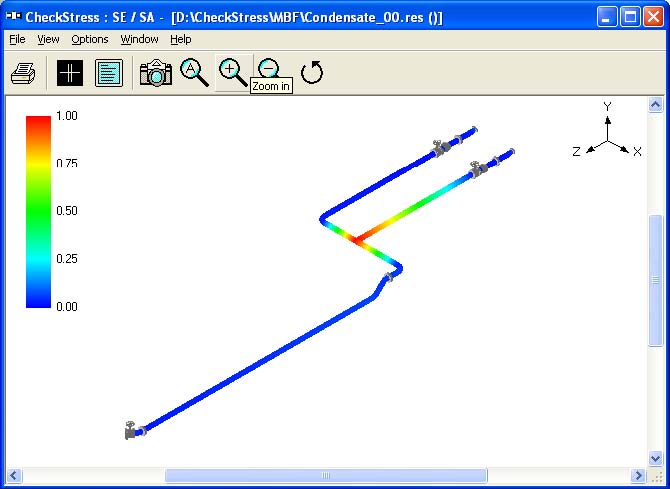
This produces high strains and hence high thermal stresses locally at the tee node 250, as shown in Fig. 5C.
![]() |
In order to reduce these thermal stresses at node 250, we cut the straight pipe between nodes 220 and 280 (Fig. 5A) into two parts – one part is the pipe from nodes 220 to 250, and the second part from nodes 250 to 280 is shifted downstream towards the two pumps, resulting in the modified layout shown in Fig. 5D, with modified node numbers automatically generated by checkSTRESS.
![]() |
This shift of pipe downstream does not adversely increase the pressure drop between the tank at node 10 and the pump suction nozzles at nodes 430 and 610 in Fig. 5D. From the thermal deformation plot for this revised layout shown in Fig. 5E, we can see that the two pump suction lines from the suction nozzles to the welding tee at node 280 have almost equal thermal growth towards the tank, resulting in lower thermal stresses in that branch pipe as seen in Fig. 5F below.
![]() |
In addition, we observe from Fig. 5E that the two pump suction lines make the bend node 250 grow thermally towards the tank, whereas the pipe from the tank node 10 to the bend node 220 grows in the opposite direction. These opposing deflections rotate the interconnecting pipe between nodes 220 and 250 like a (horizontal) “see-saw” in the horizontal XZ plane, resulting in lower thermal stresses in this region, as observed in Fig. 5F.
![]() |
Although the thermal stress criteria have been met, the weight stresses exceed the sustained stress allowable, as illustrated by many red and orange areas in the sustained stress contour plot given in Fig 5G.
![]() |
This is because there are no vertical supports (excluding the 3 nozzles and a variable spring hanger near the tank to accommodate any tank settlement) to carry the weight of the system. Vertical resting supports are therefore introduced as shown in Fig. 5H.
![]() |
The recalculated sustained stress (i.e., weight + pressure) contour plot (with most areas in blue) shown in Fig. 5I are now well below the allowable stress values, and hence code-compliant.
![]() |